
Finding Rest, Strength, and Hope in Christ the Cornerstone
Introduction
Life has a way of leaving us exhausted. Some days we feel overwhelmed by responsibilities, disappointed by unanswered prayers, or discouraged by hardships that seem impossible to overcome. During those moments, many believers long for a place of peace—a solid foundation where they can rest without fear.Throughout Scripture, rocks symbolize strength, protection, permanence, and God’s unchanging faithfulness. Because of this rich biblical symbolism, many Christians search for Bible verses about Jesus sitting on a rock, wondering whether the Bible records such an event and what spiritual lessons it teaches.
While the Bible does not specifically describe Jesus sitting on a rock in a famous, direct passage using those exact words, it does frequently portray Him teaching on mountainsides, resting in nature, praying in solitary places, and identifying Himself as the true Rock and the Cornerstone upon whom believers build their lives. Rocks also appear throughout both the Old and New Testaments as powerful symbols pointing to Christ’s strength, stability, authority, and salvation.Understanding these passages can transform how we view life’s difficulties. When everything around us feels uncertain, Jesus remains the unshakable Rock who offers security, wisdom, and eternal hope.
Whether you’re studying Scripture, preparing a Bible lesson, writing a devotional, or simply seeking encouragement, this guide explores the biblical meaning behind rocks, Jesus’ relationship with them, and the verses that reveal why Christ is the firm foundation every believer needs.
Quick Answer
Does the Bible say Jesus sat on a rock?
The Bible does not contain a well-known verse that explicitly says, “Jesus sat on a rock.” However, Scripture frequently describes Jesus sitting while teaching crowds, praying in mountainous places, and ministering outdoors where rocks naturally surrounded Him (Matthew 5:1–2; Matthew 24:3; John 8:2). More importantly, the Bible repeatedly presents Jesus as the Rock, the Chief Cornerstone, and the sure foundation of every believer’s life (1 Corinthians 10:4; Ephesians 2:20; 1 Peter 2:6–8).
The deeper biblical message is not about the physical rock Jesus may have sat upon but about what the rock represents—His strength, faithfulness, authority, and everlasting salvation.
What Does the Bible Say About Jesus and Rocks?
Before examining individual verses, it’s helpful to understand why rocks are so significant throughout Scripture.
In biblical times, rocks provided shelter from storms, protection from enemies, strong foundations for buildings, and places of worship or remembrance. Because they were stable and enduring, God often used rocks to symbolize His own character.
When the New Testament reveals Jesus as the Rock, it identifies Him as:
- Our unchanging foundation
- Our source of spiritual life
- Our refuge during trials
- The Cornerstone of God’s Kingdom
- The One who provides lasting security
Even when Jesus taught outdoors, climbed mountains, or withdrew into wilderness places, those settings reflected profound spiritual truths. Nature often became His classroom, reminding listeners that God’s creation points to eternal realities.
Bible Verses About Jesus, the Rock, and His Foundation
1. 1 Corinthians 10:4 — Christ Is the Spiritual Rock
Scripture
“…For they drank from the spiritual Rock that followed them, and the Rock was Christ.” (ESV)
Meaning and Context
Paul reminds believers about Israel’s journey through the wilderness. God miraculously provided water from a rock, preserving His people in impossible circumstances.
Paul explains that this miracle pointed beyond Moses to Jesus Christ Himself. Christ was the true spiritual Rock sustaining God’s people then and now.
The Old Testament event becomes a picture of God’s eternal provision through Jesus.
Practical Application
Life often feels like wandering through a wilderness.
Financial struggles.
Family conflicts.
Health concerns.
Loneliness.
Spiritual dryness.
In every season, Jesus remains the source of living water. Just as Israel depended entirely upon God’s miraculous provision, believers today rely upon Christ for spiritual strength.
Why This Verse Matters Today
Many people seek stability in careers, relationships, or possessions. Eventually those foundations can fail.
Jesus never does.
He remains the Rock that continually provides grace, hope, and life.
2. Matthew 7:24–25 — Building on the Rock
Scripture
“Therefore everyone who hears these words of mine and puts them into practice is like a wise man who built his house on the rock.”
Meaning and Context
Jesus concludes the Sermon on the Mount with one of His most memorable illustrations.
Two builders construct houses.
One chooses rock.
The other chooses sand.
The storms come to both.
Only one house survives.
The difference wasn’t the storm—it was the foundation.
Practical Application
Storms are unavoidable.
Every believer faces:
- Loss
- Disappointment
- Temptation
- Uncertainty
- Grief
- Unexpected change
Those who obey Christ discover that faith anchored in Him remains secure regardless of circumstances.
Modern Reflection
Today’s culture often encourages people to build their identity upon popularity, success, wealth, or personal achievement.
Jesus offers something far stronger.
He invites us to build our lives on eternal truth rather than temporary security.
3. Psalm 18:2 — The Lord Is My Rock
Scripture
“The Lord is my rock and my fortress and my deliverer…”
Meaning and Context
David wrote this psalm after experiencing God’s repeated deliverance from enemies.
Having hidden among rocky cliffs while fleeing Saul, David understood firsthand how rocks provided protection.
He compared God’s faithfulness to those massive cliffs that sheltered him.
Connection to Jesus
Although written centuries before Christ’s earthly ministry, Christians understand this verse in light of Jesus, who fully reveals God’s saving power.
Jesus becomes our ultimate refuge from sin, fear, and eternal separation from God.
Practical Application
Whenever anxiety overwhelms you, remember David’s confidence.
Instead of allowing fear to define your future, stand firmly upon God’s promises.
Jesus remains the same secure refuge today.
4. Isaiah 28:16 — The Precious Cornerstone
Scripture
“See, I lay a stone in Zion, a tested stone, a precious cornerstone for a sure foundation…”
Meaning and Context
Isaiah prophesied about the coming Messiah centuries before Jesus was born.
The cornerstone determined the stability of an entire building.
If it was perfectly placed, every other stone aligned correctly.
Isaiah reveals that God’s coming Savior would become that perfect cornerstone.
Fulfillment in Christ
The New Testament repeatedly identifies Jesus as the fulfillment of this prophecy (Romans 9:33; 1 Peter 2:6).
Everything about the Christian life begins with Him.
Practical Application
When life feels confusing, return to Christ.
Instead of allowing culture to determine your priorities, let Jesus shape your decisions, relationships, and purpose.
He keeps life aligned with God’s will.
5. Matthew 16:18 — Upon This Rock
Scripture
“And I tell you that you are Peter, and on this rock I will build my church…”
Meaning and Context
This passage has generated theological discussion for centuries.
Regardless of differing interpretations regarding Peter’s role, Christians broadly agree that Christ Himself is the true foundation of His Church.
The Church stands because Jesus established it.
No human leader can replace Him.
Practical Application
Churches flourish when they remain centered upon Christ rather than personalities or traditions.
Our confidence rests in Jesus’ authority and His promise that the gates of hell will never overcome His Church.
Why It Encourages Believers
No matter how uncertain the world becomes, Christ continues building His Church.
His Kingdom cannot be shaken.
Jesus Often Taught While Sitting
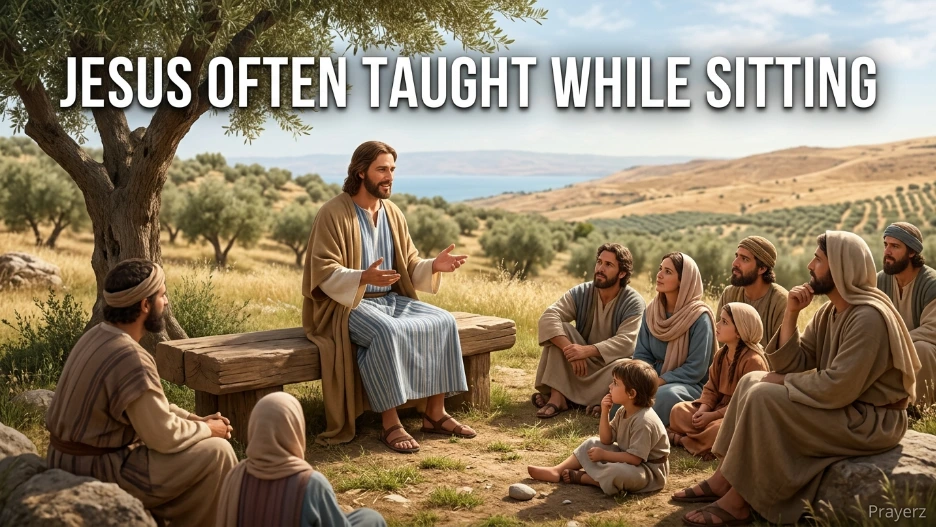
Although Scripture doesn’t emphasize Jesus sitting specifically on a rock, it frequently records Him sitting while teaching people. In Jewish culture, a rabbi commonly sat down to teach, while listeners stood or sat around Him.
For example:
Matthew 5:1–2 — The Sermon on the Mount
Jesus went up a mountainside, sat down, and began teaching His disciples. While the text does not mention a rock, the mountainous setting almost certainly included rocky terrain. The focus is not on the object He sat upon but on the divine authority with which He taught the Beatitudes and revealed the values of God’s Kingdom.
Matthew 24:3 — Jesus on the Mount of Olives
As Jesus sat on the Mount of Olives, His disciples privately asked Him about the future, leading to His profound teaching concerning the end times, His return, and the importance of remaining faithful.
John 8:2 — Teaching in the Temple
Jesus sat down in the temple courts and taught the people. Again, His posture reflects the role of a respected teacher, emphasizing wisdom, authority, and compassionate instruction.
These passages remind us that wherever Jesus sat—whether on a hillside, in the temple, or on the Mount of Olives—His words brought life, truth, and hope to those willing to listen.
Old Testament Rock Symbolism That Points to Jesus
One of the beautiful themes running throughout the Bible is that many Old Testament events foreshadow Jesus Christ. These are often called “types” or “shadows” that find their complete fulfillment in Him. Rocks play a significant role in this biblical pattern.
When we understand these passages, we gain a richer appreciation for why the New Testament repeatedly calls Jesus “the Rock.”
6. Exodus 17:5–6 — Water from the Rock
Scripture
“The LORD answered Moses, ‘Go out in front of the people… Strike the rock, and water will come out of it for the people to drink.'”
Meaning and Context
Shortly after leaving Egypt, the Israelites found themselves in a dry wilderness without water. Their fear quickly turned into complaints against Moses and even against God.
Instead of abandoning His people, God instructed Moses to strike a rock at Horeb. Miraculously, fresh water flowed out, providing life for the entire nation.
Centuries later, Paul explained that this miraculous rock ultimately pointed to Christ (1 Corinthians 10:4).
Just as water flowed from the rock to satisfy physical thirst, Jesus provides the living water that satisfies the deepest spiritual thirst of every human heart (John 4:13–14; John 7:37–38).
Practical Application
Many people spend years searching for satisfaction in success, wealth, relationships, entertainment, or recognition.
Eventually those things leave them thirsty again.
Only Jesus offers lasting peace.
When life’s pressures leave your soul exhausted, return to Christ rather than temporary solutions.
Why This Verse Matters Today
God still provides for His people.
Although He may not send water from a physical rock today, He continually refreshes weary hearts through His Word, His Spirit, and His unfailing presence.
7. Deuteronomy 32:4 — The Rock Is Perfect
Scripture
“He is the Rock, his works are perfect, and all his ways are just.”
Meaning and Context
Moses spoke these words near the end of his life.
After leading Israel for forty years, he reflected on God’s unwavering character.
Unlike human leaders who fail, God remained completely faithful.
His justice was perfect.
Wisdom was flawless.
His promises never changed.
Although this verse speaks directly of God the Father, Christians understand Jesus to share the same divine nature (John 1:1; Colossians 2:9).
Therefore, Christ also demonstrates the perfection and faithfulness described here.
Practical Application
People disappoint us.
Institutions fail.
Cultures change.
Opinions shift.
Jesus never changes.
When your confidence is shaken by human failure, anchor your faith in God’s perfect character rather than imperfect people.
Reflection
The Rock never crumbles.
Even when our faith feels weak, Christ remains faithful.
8. Psalm 61:2 — Lead Me to the Rock
Scripture
“Lead me to the rock that is higher than I.”
Meaning and Context
David wrote these words while feeling overwhelmed.
Instead of pretending to be strong, he admitted his weakness and asked God for help.
The “rock higher than I” represents safety beyond human ability.
It pictures God’s protection and saving power.
For Christians, this imagery beautifully points to Jesus, who lifts believers above despair and provides eternal security.
Practical Application
There are seasons when problems feel bigger than our strength.
During those moments, prayer becomes our pathway to the Rock.
Rather than carrying every burden alone, we can confidently bring them before Christ.
Modern Reflection
This verse reminds believers that asking for God’s help is not weakness.
It is an act of faith.
9. Isaiah 26:4 — The Everlasting Rock
Scripture
“Trust in the LORD forever, for the LORD, the LORD himself, is the Rock eternal.”
Meaning and Context
Isaiah contrasts temporary earthly kingdoms with God’s everlasting reign.
Everything in this world eventually changes.
Empires rise and fall.
Economies fluctuate.
Health declines.
People age.
God alone remains forever.
Jesus shares this eternal nature.
Hebrews 13:8 declares:
“Jesus Christ is the same yesterday and today and forever.”
Practical Application
When life feels unstable, remember that Christ is not influenced by changing circumstances.
His love remains constant.
Promises remain trustworthy.
His grace never expires.
Why This Verse Is Encouraging
Your security rests in Someone who never changes.
That truth provides lasting peace.
10. 1 Peter 2:6–8 — The Living Cornerstone
Scripture
“See, I lay a stone in Zion, a chosen and precious cornerstone…”
Meaning and Context
Peter combines several Old Testament prophecies to explain Jesus’ identity.
Some people accept Christ and discover eternal life.
Others reject Him and stumble spiritually.
The cornerstone determines the direction of the entire building.
Likewise, our response to Jesus shapes both our present lives and our eternal future.
Practical Application
Faith is more than believing facts about Jesus.
It means building every part of life upon Him.
Marriage.
Family.
Career.
Finances.
Relationships.
Dreams.
Everything becomes stronger when Christ is the foundation.
Reflection
The strongest life is not built upon talent.
It is built upon Jesus.
11. Ephesians 2:20 — Christ the Cornerstone
Scripture
“…built on the foundation of the apostles and prophets, with Christ Jesus himself as the chief cornerstone.”
Meaning and Context
Paul describes the Church as God’s spiritual building.
The apostles proclaimed the gospel.
The prophets pointed toward God’s plan.
But Jesus Himself holds everything together.
Without Him, there is no Church.
No salvation.
No hope.
Practical Application
Believers belong to something much greater than themselves.
Every Christian becomes part of God’s family through Christ.
This truth encourages unity, humility, and love within the Church.
Why Do Christians Search for “Jesus Sitting on a Rock”?
Many people encounter paintings, illustrations, devotionals, or movies showing Jesus sitting on a rock while teaching, praying, or comforting others.
Although Scripture doesn’t specifically highlight this detail, these artistic portrayals often capture biblical truths.
They remind us that Jesus:
- Lived among ordinary people.
- Taught in natural outdoor settings.
- Prayed in lonely places.
- Welcomed anyone who came to Him.
- Was approachable and compassionate.
- Used creation to illustrate heavenly truths.
Whether Jesus sat on a hillside, a stone, or the ground, His message remained the same:
“Come to me, all who labor and are heavy laden, and I will give you rest.” (Matthew 11:28)
The emphasis is not the rock beneath Him but the Savior who offers rest to weary souls.
Lessons We Learn from Jesus and the Symbolism of the Rock
1. Jesus Is Our Secure Foundation
Storms reveal foundations.
Faith rooted in Christ remains steady through suffering.
When disappointments come, believers discover that God’s promises are stronger than life’s uncertainties.
2. Jesus Provides Rest
Crowds constantly surrounded Jesus.
Yet He regularly withdrew to mountains and quiet places.
His example teaches believers the importance of resting in God’s presence rather than constantly living in stress.
Spending quiet time with Christ renews both heart and mind.
3. Jesus Offers Living Water
Just as water flowed from the rock in the wilderness, Jesus satisfies spiritual thirst.
Nothing else can replace His peace.
His forgiveness restores guilty hearts.
His grace renews weary souls.
4. Jesus Is Unchanging
Cultures change.
Technology changes.
Opinions change.
Jesus does not.
His love remains constant through every generation.
This gives believers confidence no matter what happens around them.
5. God’s Word Is Worth Building Upon
Many foundations compete for our attention:
- Popular opinion
- Social media
- Money
- Success
- Personal feelings
Jesus teaches that lasting wisdom comes through hearing and obeying God’s Word.
His truth never goes out of date.
Related Bible Verses About Rocks and God’s Faithfulness
Several additional passages strengthen this biblical theme:
- Psalm 62:6 — “He only is my rock and my salvation.”
- Psalm 95:1 — “Let us shout aloud to the Rock of our salvation.”
- Psalm 31:3 — “Since you are my rock and my fortress…”
- 2 Samuel 22:47 — “The LORD lives! Praise be to my Rock!”
- Luke 6:47–49 — Jesus repeats the illustration of building on the rock.
- Romans 9:33 — Christ is the cornerstone chosen by God.
- Revelation 1:8 — Jesus is the Alpha and the Omega, emphasizing His eternal nature.
Together, these passages consistently point to God’s strength, permanence, protection, and salvation fulfilled in Jesus Christ.
How to Apply These Bible Verses About Jesus Sitting on a Rock in Daily Life
Reading Scripture is valuable, but its greatest impact comes when we allow God’s Word to shape the way we live. The biblical imagery of Jesus as the Rock isn’t merely poetic—it offers practical guidance for everyday challenges. Here are several ways to apply these truths.
1. Build Your Life on Christ’s Teachings
Jesus concluded the Sermon on the Mount by comparing obedience to building a house on solid rock (Matthew 7:24–25). Hearing His words is important, but putting them into practice is what creates a firm foundation.
Ask yourself:
- Am I making decisions according to God’s Word?
- Do I seek Christ’s wisdom before acting?
- Is my faith visible in how I treat others?
The stronger your foundation in Scripture, the steadier you’ll remain when life’s storms arrive.
2. Turn to Jesus During Difficult Seasons
Every believer experiences trials. Illness, financial setbacks, grief, broken relationships, and uncertainty can shake our confidence. Instead of relying solely on your own strength, make Jesus your first refuge.
Practical ways to do this include:
- Begin each day with prayer.
- Read a portion of Scripture daily.
- Memorize verses about God’s faithfulness.
- Worship even when circumstances are difficult.
- Share your burdens with trusted Christian friends.
When Christ is your Rock, you can face challenges with hope instead of fear.
3. Spend Quiet Time with God
The Gospels frequently show Jesus withdrawing to mountains and solitary places to pray. Whether He sat on a hillside, a rock, or the ground, He intentionally sought fellowship with the Father.
His example reminds us to slow down and create space for God.
Consider setting aside time each day to:
- Read the Bible without distractions.
- Listen quietly in prayer.
- Reflect on God’s goodness.
- Journal what you’re learning.
- Thank God for His daily blessings.
These simple habits deepen your relationship with Christ and strengthen your faith.
4. Trust God’s Stability in an Unstable World
News headlines, changing circumstances, and personal disappointments can easily create anxiety. Yet Scripture repeatedly reminds us that Jesus is the same yesterday, today, and forever (Hebrews 13:8).
When you feel overwhelmed, remind yourself of these truths:
- God’s promises never fail.
- Christ’s love never changes.
- His grace is sufficient.
- His plans are trustworthy.
- His presence never leaves His people.
This confidence allows believers to experience peace even during uncertainty.
5. Share the Hope You’ve Found
The Rock is not meant to be kept to ourselves. As followers of Christ, we’re called to point others to the One who offers lasting hope.
Look for opportunities to:
- Encourage someone with Scripture.
- Pray for a hurting friend.
- Share your testimony.
- Invite someone to church or Bible study.
- Live in a way that reflects Christ’s love.
People around you may be searching for the same solid foundation you’ve found in Jesus.
A Heartfelt Prayer
Heavenly Father,
Thank You for being my Rock, my refuge, and my unchanging source of hope. When life feels uncertain, remind me that my security is not found in circumstances but in Jesus Christ.
Help me build every part of my life upon Your truth. Give me wisdom to follow Your Word, courage to trust You during difficult seasons, and peace that overcomes fear.
Lord Jesus, thank You for being the Cornerstone of my faith. Thank You for providing living water when my soul is weary and for remaining faithful even when I struggle.
Teach me to spend time in Your presence, to rest in Your promises, and to reflect Your love to those around me. Strengthen my faith so that when storms come, I will remain firmly rooted in You.
May my life point others to the hope, grace, and salvation found only in Christ.
In Jesus’ mighty name,
Amen.
FAQs
1. Does the Bible actually say Jesus sat on a rock?
The Bible does not contain a specific verse stating that Jesus sat on a rock. However, it frequently describes Him sitting while teaching (Matthew 5:1–2; Matthew 24:3; John 8:2). Since many of these events occurred outdoors on hillsides and mountains, artistic depictions often portray Him sitting on a rock, though Scripture does not explicitly mention it.
2. Why are rocks so important in the Bible?
Rocks symbolize strength, stability, protection, permanence, and God’s faithfulness. Throughout both the Old and New Testaments, they serve as powerful reminders that God is dependable and unchanging.
3. Is Jesus called the Rock in Scripture?
Yes. One of the clearest references is 1 Corinthians 10:4, where Paul writes that “the Rock was Christ.” Jesus is also described as the Chief Cornerstone (Ephesians 2:20; 1 Peter 2:6–8), emphasizing that He is the foundation of the Christian faith.
4. What is the spiritual meaning of Jesus as the Rock?
Jesus as the Rock represents security, salvation, strength, and unwavering faithfulness. Believers can confidently build their lives on Him because He never changes and His promises never fail.
5. What does Matthew 7 teach about building on the rock?
In Matthew 7:24–25, Jesus teaches that those who hear His words and obey them are like wise builders who construct their house on solid rock. The lesson is that obedience to Christ creates a strong spiritual foundation capable of withstanding life’s storms.
6. What does the Cornerstone symbolize?
The cornerstone was the most important stone in ancient construction, determining the alignment and stability of the entire building. Jesus is called the Chief Cornerstone because He is central to God’s plan of salvation and the foundation of His Church.
7. How does the rock in the wilderness point to Jesus?
In Exodus 17, God brought water from a rock to sustain Israel. Paul later explains in 1 Corinthians 10:4 that this miracle foreshadowed Christ, who provides the living water of eternal life to all who believe in Him.
8. How can I make Jesus the foundation of my life?
You make Jesus the foundation of your life by trusting Him as Savior, reading and obeying Scripture, praying regularly, participating in Christian fellowship, and seeking His guidance in every area of life.
9. What other Bible verses describe God as a Rock?
Many passages use this imagery, including Psalm 18:2, Psalm 62:6, Psalm 95:1, Isaiah 26:4, Deuteronomy 32:4, and 2 Samuel 22:47. These verses emphasize God’s strength, faithfulness, and protection.
10. What encouragement can believers find in these verses today?
These passages remind us that while circumstances constantly change, Jesus never does. He remains our secure refuge, faithful Savior, wise Teacher, and everlasting foundation. No matter what challenges we face, we can confidently trust Him.
Final Encouragement
When people search for Bible verses about Jesus sitting on a rock, they often hope to find a vivid image of the Savior resting in the midst of God’s creation. Although the Bible does not specifically record Jesus sitting on a rock, it reveals something even more profound.
It tells us that Jesus is the Rock.
He is the solid foundation beneath weary hearts, the Cornerstone of God’s Kingdom, the source of living water, and the refuge that never fails. Throughout Scripture, rocks symbolize God’s strength, permanence, and faithfulness—and all of these qualities find their perfect fulfillment in Christ.Life will bring storms. There will be seasons of uncertainty, disappointment, and sorrow. Yet those who build their lives on Jesus discover a peace that circumstances cannot steal and a hope that never fades.
So whenever you picture Jesus teaching on a mountainside or praying in a quiet place, remember the greater truth behind the image: He is inviting you to rest in Him. He calls you to leave the shifting sands of fear, self-reliance, and worldly security and stand instead on the firm foundation of His love and truth.
May these Scriptures encourage you to trust Christ more deeply, walk faithfully in His ways, and confidently proclaim with the psalmist:
“The LORD is my rock and my fortress and my deliverer.” — Psalm 18:2
No matter where life leads, the Rock of Ages will never fail. Build your life on Him, and you will find strength, hope, and lasting peace that endures forever.
