

There is something beautiful about a young person who chooses to give their life to God.
While the world often tells young people to chase popularity, success, money, pleasure, appearance, and recognition, Scripture offers a different invitation: know your Creator, follow His ways, use your gifts for His glory, and serve Him while you are young.
Yet serving God as a young person is not always easy.
Young Christians may wonder, “Am I too young for God to use me?” Others may feel pressured by friends, distracted by social media, uncertain about their future, or afraid that following Christ will cause them to miss out on life. Some have a genuine desire to serve God but do not know where to begin. Others may have made mistakes and wonder whether God can still use them.
The Bible gives an encouraging answer.
God has never required someone to reach a certain age before becoming useful in His kingdom. Scripture repeatedly shows God working through young people who trusted Him, obeyed His Word, developed godly character, and stepped forward in faith.
Samuel heard God’s voice while he was still young. David learned to trust God before he became king. Josiah sought the Lord while he was young. Timothy became a faithful ministry partner of Paul. Mary responded to God’s calling with humble faith. Daniel and his friends remained faithful to God while living in a culture that pressured them to compromise.
These examples remind us that youth is not a spiritual disadvantage when it is surrendered to God.
The question is not simply how old you are.
The deeper question is: What are you doing with the years, abilities, opportunities, and influence God has given you?
The Bible verses about youth serving God in this article can help young believers understand their identity, develop spiritual strength, resist temptation, discover purpose, serve others, and remain faithful to Christ.
Quick Answer: What Does the Bible Say About Youth Serving God?
The Bible encourages young people to remember their Creator, seek God early, live as examples to others, obey His Word, develop godly character, and use their gifts to serve Him.
Some of the strongest Bible verses about youth serving God include:
- Ecclesiastes 12:1 — “Remember now thy Creator in the days of thy youth.”
- 1 Timothy 4:12 — “Let no man despise thy youth; but be thou an example of the believers.”
- Psalm 119:9 — “Wherewithal shall a young man cleanse his way? by taking heed thereto according to thy word.”
- Proverbs 3:5–6 — Trust God rather than depending entirely on your own understanding.
- 2 Timothy 2:22 — Flee youthful lusts and pursue righteousness, faith, charity, and peace.
- Joshua 1:9 — Be strong and courageous because God is with you.
- Psalm 71:5 — God can be trusted from youth onward.
Together, these passages show that serving God in youth involves more than participating in church activities. It means building a life around God—your choices, relationships, speech, priorities, character, dreams, and future.
What Does the Bible Say About Youth Serving God?
The Bible does not portray young people as merely the future of God’s kingdom. Young believers can serve God right now.
This distinction matters.
It is easy to tell teenagers and young adults, “Someday, when you are older, God can use you.” Scripture presents a much more active picture. Young people are called to learn God’s Word, resist sin, demonstrate godly character, encourage others, share their faith, and faithfully use what God has entrusted to them.
Paul’s words to Timothy are especially important:
“Let no man despise thy youth; but be thou an example of the believers, in word, in conversation, in charity, in spirit, in faith, in purity.” — 1 Timothy 4:12
Bible Gateway’s presentation of this passage similarly emphasizes that Timothy’s youth was not a reason for spiritual inactivity; instead, his speech, conduct, love, faith, and purity were to become examples for other believers.
Paul did not tell Timothy to wait until he was older before becoming useful.
He told him to be an example.
That is a powerful principle for Christian youth today.
Serving God begins with the person you are becoming, not merely the ministry position you hold.
A young Christian may serve God by:
- Studying Scripture faithfully
- Praying for friends and family
- Encouraging someone who is struggling
- Helping at church
- Serving people in need
- Sharing the gospel
- Refusing sinful peer pressure
- Treating parents and teachers with respect
- Using talents to glorify God
- Showing Christlike love at school or work
- Being honest when dishonesty would be easier
- Choosing purity when culture encourages compromise
Godly service is not restricted to a microphone, pulpit, mission trip, or formal ministry title.
Sometimes the most powerful ministry happens in ordinary moments.
1. Ecclesiastes 12:1 — Remember Your Creator While You Are Young
“Remember now thy Creator in the days of thy youth, while the evil days come not, nor the years draw nigh…” — Ecclesiastes 12:1
This is one of the clearest Bible verses about youth serving God.
The writer of Ecclesiastes encourages young people not to postpone their relationship with God.
Notice the word “now.”
The invitation is immediate.
Do not wait until life becomes easier.
Not wait until you have achieved your goals.
Do not wait until you are married, financially secure, finished with school, retired, or facing a crisis.
Remember your Creator now.
The context of Ecclesiastes is important. The book repeatedly examines the temporary nature of earthly achievements, pleasures, possessions, and human accomplishments. Near the end, the writer directs attention back to God.
Youth brings energy, opportunity, learning, strength, and many years ahead. But those years are not guaranteed to unfold exactly as we imagine.
How young people can apply this verse
Begin building your relationship with God today.
Read Scripture before allowing your phone to dominate the first part of your morning. Pray about your decisions. Attend church faithfully. Ask mature Christians questions. Learn to worship God when life is good rather than remembering Him only when life becomes difficult.
Why it matters today
Young people live in a culture filled with distractions. Ecclesiastes reminds us that none of those distractions can replace the Creator.
Your youth is not something to waste while waiting for “real life” to begin.
Your life with God is already happening.
2. 1 Timothy 4:12 — Do Not Let Your Age Limit Your Witness
“Let no man despise thy youth; but be thou an example of the believers, in word, in conversation, in charity, in spirit, in faith, in purity.” — 1 Timothy 4:12
Timothy was young, yet Paul entrusted him with significant spiritual responsibility.
The answer to being underestimated was not arrogance.
It was character.
Paul identified several areas where Timothy could become an example:
In your words
What you say matters.
Young Christians can honor Christ by refusing gossip, cruelty, vulgarity, unnecessary arguments, and dishonest speech.
Proverbs 15:1 reminds us that a soft answer can turn away wrath.
In your conduct
Faith should become visible through behavior.
People should be able to see integrity in the way a Christian handles schoolwork, employment, friendships, money, responsibilities, and commitments.
In love
Christian service is not about proving that you are spiritually superior.
It is about loving people.
Jesus taught that His followers would be recognized by their love (John 13:35).
In faith
Young believers will encounter uncertainty. They may not understand everything God is doing.
Faith means continuing to trust Him even when the future is unclear.
In purity
Purity includes thoughts, motives, relationships, sexuality, entertainment, online behavior, and the things we allow to shape our hearts.
This passage gives young Christians a practical blueprint for serving God.
You do not need to wait for a title.
Start with your character.
3. Psalm 119:9 — Let God’s Word Shape Your Life
“Wherewithal shall a young man cleanse his way? by taking heed thereto according to thy word.” — Psalm 119:9
Young people face countless influences.
Friends influence us.
Music influences us.
Movies influence us.
Social media influences us.
Algorithms influence us.
Celebrities influence us.
Teachers, coworkers, family members, and cultural trends can all influence our thinking.
Psalm 119:9 asks how a young person can keep their life spiritually clean.
The answer is God’s Word.
The verse does not suggest that young people can remain faithful through willpower alone.
They need truth.
Need God’s wisdom.
They need Scripture to correct false ideas and establish righteous priorities.
Practical application
Instead of asking only, “Is this popular?” ask:
“Does this agree with God’s Word?”
Before entering a relationship, ask whether the relationship encourages you toward Christ.
Consuming entertainment, consider what it is teaching your heart.
Before making a major decision, seek biblical wisdom rather than simply following emotion.
Psalm 119:105 adds:
“Thy word is a lamp unto my feet, and a light unto my path.”
God’s Word does not always reveal the entire road ahead.
But it gives enough light for the next faithful step.
4. 2 Timothy 2:22 — Run From Temptation and Pursue Righteousness
“Flee also youthful lusts: but follow righteousness, faith, charity, peace…” — 2 Timothy 2:22
This verse is particularly relevant to young Christians.
Paul does not merely say, “Resist temptation.”
He says “flee.”
There are situations where spiritual maturity means recognizing your vulnerability and getting away from the temptation.
That could mean:
- Ending a harmful relationship
- Blocking inappropriate content
- Leaving a compromising environment
- Changing unhealthy friendships
- Refusing secret conversations
- Asking for accountability
- Getting help when a habit is controlling you
But Paul gives both sides of discipleship.
Do not only run from something.
Run toward something.
Pursue righteousness.
Faith.
Pursue love.
Peace.
A young Christian cannot build a strong spiritual life simply by making a list of things they refuse to do. They need something better to pursue.
Modern relevance
A young person who spends all their energy asking, “How close can I get to sin without technically crossing the line?” is asking the wrong question.
A better question is:
“What will help me become more like Christ?”
That change in perspective can transform everyday choices.
5. Proverbs 3:5–6 — Trust God With Your Future
“Trust in the LORD with all thine heart; and lean not unto thine own understanding. In all thy ways acknowledge him, and he shall direct thy paths.” — Proverbs 3:5–6
Youth often comes with major decisions.
What career should I choose?
Where should I study?
Who should I marry?
Where should I live?
What should I do with my talents?
How do I know God’s will?
These questions can create tremendous anxiety.
Proverbs 3:5–6 offers a foundation: trust God.
This does not mean young people should stop thinking, planning, studying, or seeking wise counsel.
It means human understanding should never become more trustworthy than God.
Practical application
Pray before making major decisions.
Search Scripture.
Seek advice from mature Christians.
Examine your motives.
Be willing to change direction when God’s Word exposes a wrong path.
Then move forward in faith.
Serving God does not mean knowing every detail of your future.
It means trusting the One who does.
6. Joshua 1:9 — Be Strong and Courageous
“Have not I commanded thee? Be strong and of a good courage; be not afraid, neither be thou dismayed: for the LORD thy God is with thee whithersoever thou goest.” — Joshua 1:9
Joshua faced an enormous responsibility.
Moses was gone, and Joshua had to lead Israel.
God repeatedly encouraged him to be strong and courageous.
Although this passage is not specifically addressed to youth, its principle is deeply valuable for young Christians.
Serving God requires courage.
You may be the only Christian in your friend group.
May need to say no when everyone else says yes.
You may need to stand for truth when it costs you popularity.
May feel inadequate to serve.
Joshua 1:9 reminds believers that courage is rooted not merely in confidence in ourselves but in confidence that God is with us.
You do not need to be fearless to obey God.
You need to trust Him while you are afraid.
7. Psalm 71:5 — Build a Lifelong Faith From Your Youth

“For thou art my hope, O Lord GOD: thou art my trust from my youth.” — Psalm 71:5
This verse presents something beautiful: faith that begins early and continues throughout life.
The goal of youth ministry is not merely to create emotionally exciting experiences.
The goal is to cultivate a lasting relationship with God.
A young person who learns to pray during difficulty is developing a habit that can sustain them for decades.
A teenager who learns to search Scripture for wisdom is building spiritual instincts for adulthood.
A young adult who learns to trust God with money, relationships, career decisions, and disappointments is developing a foundation for the future.
Reflection
Do not underestimate what God can build in you now.
Today’s prayer may shape tomorrow’s faith.
Obedience may protect tomorrow’s testimony.
Today’s knowledge of Scripture may become tomorrow’s wisdom.
8. Proverbs 20:29 — Recognize the Strength God Gives Young People
“The glory of young men is their strength: and the beauty of old men is the gray head.” — Proverbs 20:29
The Bible does not portray youth as worthless or insignificant.
Young people have strength.
They have energy.
They often have creativity, adaptability, enthusiasm, and a willingness to learn.
Those qualities can become powerful tools for God’s kingdom when surrendered to Him.
A young person can serve by organizing a church project, helping children, learning technology, assisting elderly believers, participating in missions, creating Christian content, visiting someone who is lonely, or simply becoming dependable in the local church.
The important question is not whether you possess strength.
It is how you use it.
Strength can be spent on selfish ambition or surrendered for God’s glory.
9. 1 Peter 5:5 — Serve With Humility
“Likewise, ye younger, submit yourselves unto the elder. Yea, all of you be subject one to another, and be clothed with humility…” — 1 Peter 5:5
Serving God is not about becoming famous.
It is not about proving that you are better than older Christians.
It is not about demanding recognition.
Biblical service requires humility.
Young believers can learn from older Christians who have walked with God through seasons of suffering, marriage, parenting, grief, work, failure, forgiveness, and perseverance.
At the same time, older believers should recognize that young Christians have valuable gifts and perspectives.
The church needs both generations.
Healthy Christian discipleship is not competition between generations.
It is cooperation within the body of Christ.
10. 2 Timothy 1:7 — God Gives Courage, Love, and Self-Control
“For God hath not given us the spirit of fear; but of power, and of love, and of a sound mind.” — 2 Timothy 1:7
Timothy apparently needed encouragement to remain bold in his ministry.
Many young Christians understand that feeling.
They want to speak about Jesus but are afraid of rejection.
Want to serve but fear failure.
They want to stand for biblical truth but worry about what people will think.
This verse reminds believers that fear does not have to control their obedience.
God gives power.
Gives love.
God gives a sound mind.
Christian courage is not aggressive behavior or argumentative speech. It is the ability to remain faithful while treating others with love and wisdom.
11. Ecclesiastes 11:9 — Enjoy Youth Without Forgetting God
“Rejoice, O young man, in thy youth; and let thy heart cheer thee in the days of thy youth…” — Ecclesiastes 11:9
An important biblical truth is sometimes missed: God is not against young people enjoying life.
Christianity does not require young people to become joyless, isolated, or afraid of every ordinary pleasure.
Ecclesiastes encourages young people to rejoice while also remembering that their lives belong to God.
The issue is not whether you enjoy life.
The issue is whether enjoyment becomes your god.
There is a difference between enjoying God’s gifts and worshiping His gifts.
Young Christians can enjoy friendships, hobbies, sports, education, creativity, travel, music, nature, family, and healthy recreation while keeping God at the center.
The Christian life is not about escaping joy.
It is about discovering better joy in God.
Young People in the Bible Who Served God
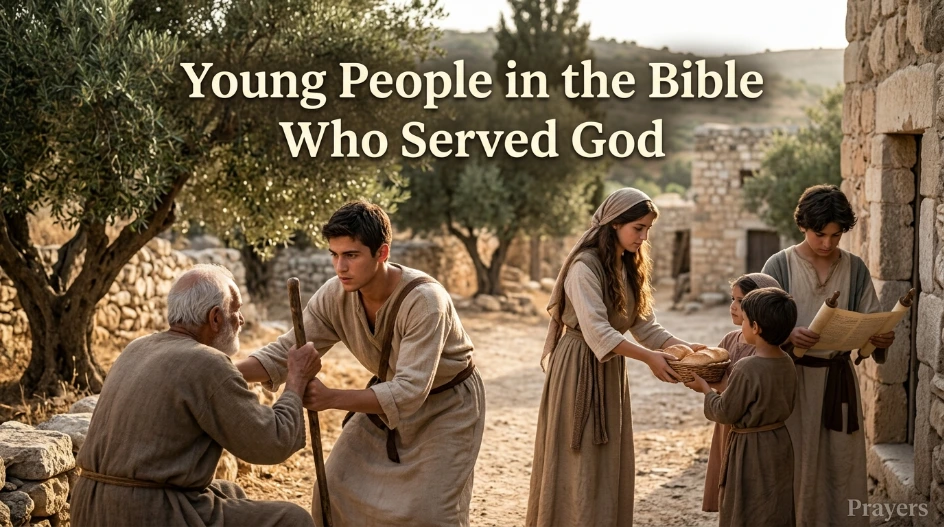
The biblical record gives us many examples of young people whom God used.
Samuel
Samuel served in the house of the Lord while still young and learned to recognize God’s voice (1 Samuel 3).
His story teaches that spiritual sensitivity can begin early.
Young believers should learn to listen to Scripture and respond to God’s direction.
David
David was young when he faced Goliath.
His courage did not come from trusting his physical strength. He trusted God.
David’s story reminds young Christians that God can use someone others overlook.
Josiah
Josiah became king at a young age and later led significant spiritual reforms in Judah (2 Kings 22–23).
His life demonstrates that age does not prevent meaningful spiritual influence.
Daniel
Daniel and his friends were young when they were taken into Babylonian captivity.
They lived in a culture that pressured them to compromise.
Yet they remained committed to God.
Their story is especially relevant to young believers today who are trying to remain faithful while surrounded by values that conflict with biblical teaching.
Timothy
Timothy became one of Paul’s trusted ministry companions.
His story demonstrates the importance of spiritual mentorship, faithful teaching, and godly character.
Mary
Mary responded to God’s extraordinary calling with humility and faith.
Her example reminds believers that surrender to God can require courage, trust, and willingness to accept a future they did not fully understand.
These examples have something in common:
God did not wait for them to become perfect before He called them to faithful obedience.
How Can Young People Serve God Today?
Serving God does not always require a formal ministry position.
Here are practical ways young Christians can serve God today.
1. Serve God Through Prayer
Pray for your family.
For your church.
Pray for classmates and coworkers.
For people who do not know Christ.
Prayer is not passive.
It is participation in God’s work.
2. Serve God Through Scripture
Know God’s Word.
A Christian who wants to serve others needs spiritual nourishment personally.
Read consistently rather than only when you need an inspirational verse.
Study biblical context.
Ask questions.
Memorize passages that strengthen your faith.
3. Serve God Through Your Character
Your character is part of your ministry.
Be honest.
Keep your promises.
Apologize when you are wrong.
Treat people with respect.
Refuse gossip.
Practice self-control.
Live with integrity when nobody is watching.
4. Serve God Through Your Gifts
Romans 12:6–8 teaches that believers have different gifts.
Some teach.
Encourage.
Some give.
Lead.
Some serve.
Show mercy.
You do not need someone else’s gift.
Ask God how you can use what He has already placed in your hands.
5. Serve God at Church
Volunteer.
Help set up chairs.
Assist with children’s ministry when appropriate.
Join worship or media teams if gifted.
Help with outreach.
Welcome newcomers.
Support older members.
Serve without demanding applause.
Small acts of faithfulness matter.
6. Serve God at School or Work
Your mission field may be closer than you think.
You can represent Christ through excellence, kindness, honesty, patience, and compassion.
You do not have to force religious conversations.
But when opportunities arise, be prepared to explain your faith with humility and respect (1 Peter 3:15).
7. Serve God Online
Social media can become a source of comparison, anger, vanity, or distraction.
But it can also be used for encouragement.
Share Scripture thoughtfully.
Encourage people.
Avoid unnecessary arguments.
Do not use Christian content merely to gain attention.
Let your online character reflect your faith.
How Parents and Churches Can Encourage Youth to Serve God
Young people need more than criticism.
They need discipleship.
Parents can encourage youth by praying with them, teaching Scripture, listening to their questions, allowing honest conversations about doubt and temptation, and modeling genuine faith.
Churches can help by giving young people meaningful opportunities to serve rather than treating them as spectators.
Older believers have a valuable responsibility to mentor younger Christians.
Paul’s relationship with Timothy demonstrates the importance of spiritual investment across generations.
Young people need correction when necessary, but they also need encouragement.
Instead of constantly saying, “You are too young,” Christian adults should also ask:
“How can we help you grow into the person God is calling you to become?”
What If I Have Already Made Mistakes?
Perhaps you are young and reading this with regret.
Maybe you have compromised your faith.
You have made sexual mistakes.
Maybe you have lied, cheated, rebelled, wasted time, hurt people, or walked away from God.
Your past does not have to be the end of your story.
The gospel is fundamentally about redemption.
First John 1:9 teaches that when we confess our sins, God is faithful and just to forgive us and cleanse us from unrighteousness.
Peter denied Jesus, yet Jesus restored him.
Paul persecuted the church, yet God transformed him into a powerful messenger of the gospel.
Your failures should not be treated lightly, but neither should they become an excuse to believe that God cannot redeem your life.
Repentance means turning toward God.
If you have fallen, get back up.
Seek forgiveness where necessary.
Remove yourself from destructive patterns.
Ask mature Christians for help.
Return to Scripture.
Pray honestly.
Begin again with God.
A Simple Daily Plan for Youth Who Want to Serve God
If you want to start serving God but feel overwhelmed, begin simply.
Morning
Spend a few minutes praying.
Read a portion of Scripture.
Ask: “Lord, help me honor You today.”
During the day
Look for one opportunity to serve someone.
Encourage someone.
Help someone.
Listen to someone.
Choose integrity.
When tempted
Stop.
Pray.
Remember God’s Word.
Remove yourself from the situation if necessary.
Ask for accountability when appropriate.
Evening
Review your day.
Thank God for His faithfulness.
Confess where you failed.
Ask for wisdom for tomorrow.
This simple rhythm can gradually shape your character.
Christian maturity usually grows through consistent obedience rather than occasional dramatic experiences.
A Prayer for Young People Serving God
Heavenly Father,
Thank You for every young person who desires to know You, follow You, and serve You. Thank You that You do not measure our usefulness merely by our age, accomplishments, popularity, or position. You look at the heart.
Lord, help young believers remember their Creator while they are young. Protect them from influences that pull them away from Your truth. Give them wisdom when they make decisions about friendships, relationships, education, careers, and their future.
Them courage when they feel pressured to compromise.
Give them strength when temptation is strong.
Them humility when they succeed.
Give them grace when they fail.
Teach them to love Your Word and to seek Your wisdom rather than simply following the opinions of the world.
Help them become examples in their speech, conduct, love, faith, and purity.
Show them how to use their gifts for Your glory. Give them opportunities to serve their families, churches, communities, schools, workplaces, and neighbors.
Surround them with godly mentors and faithful friends.
When they feel insignificant, remind them that You can use ordinary people for extraordinary purposes.
They are afraid, remind them that You are with them.
When they do not know their future, help them trust You one step at a time.
May their youth not be wasted on things that cannot last. May their lives become a testimony of Your grace.
In Jesus’ name, Amen.
FAQs
1. What is a good Bible verse for youth serving God?
One of the strongest is 1 Timothy 4:12, where Paul tells Timothy not to allow his youth to become a reason for others to disregard him, but instead to become an example in speech, conduct, love, faith, and purity. Ecclesiastes 12:1 is another foundational verse because it encourages young people to remember their Creator during their youth.
2. Does the Bible say young people can serve God?
Yes. Scripture contains numerous examples of young people serving God, including Samuel, David, Josiah, Daniel, Timothy, and Mary. The Bible consistently emphasizes faithfulness and character rather than treating youth as an automatic limitation.
3. How can a teenager serve God?
A teenager can serve God through prayer, Bible study, church involvement, helping others, sharing the gospel, encouraging friends, honoring parents, practicing purity, using personal talents, and living with integrity at school and online.
4. What does Ecclesiastes 12:1 mean for young people?
Ecclesiastes 12:1 encourages people to remember their Creator while they are young rather than postponing their relationship with God. The verse places youth within the larger reality that life is temporary and should be lived with God at the center.
5. What does 1 Timothy 4:12 teach young Christians?
It teaches young believers to live in such a way that their age does not become the defining feature of their testimony. Paul points specifically to speech, conduct, love, faith, and purity as areas where Timothy could demonstrate spiritual maturity.
6. How can young Christians resist temptation?
Young Christians should fill their minds with Scripture, pray consistently, avoid environments that encourage sin, establish healthy boundaries, seek accountability, and follow Paul’s instruction in 2 Timothy 2:22 to flee youthful lusts and pursue righteousness, faith, love, and peace.
7. Can God use me if I am young and inexperienced?
Absolutely. God used many people who were young or inexperienced. However, being young does not remove the need for growth. Young believers should remain teachable, seek wise counsel, study Scripture, and develop godly character.
8. What Bible verse encourages young people not to be afraid?
Joshua 1:9 is a powerful encouragement: “Be strong and of a good courage.” The foundation of that courage is God’s presence: “the LORD thy God is with thee whithersoever thou goest.”
9. How can parents encourage their children to serve God?
Parents can model genuine Christian faith, teach Scripture, pray with their children, listen to their questions, provide appropriate opportunities to serve, connect them with mature Christian mentors, and celebrate faithful character rather than focusing only on visible achievement.
10. What if a young person has walked away from God?
They can return to Him. Scripture repeatedly presents God as merciful toward repentant people. A young person should confess sin, turn away from destructive patterns, seek godly support, return to Scripture and prayer, and trust God’s grace. Failure does not have to be the final chapter.
Final Thought
Your youth is not a season God wants you to waste—it is a precious opportunity to know Him, grow in His Word, and serve Him with your gifts, energy, and passion. You do not have to wait until you are older, more experienced, or more successful before God can use your life.
Remember Ecclesiastes 12:1: “Remember now thy Creator in the days of thy youth.” Let your relationship with God become the foundation for your choices, relationships, dreams, and future. When you trust Him, resist temptation, walk in obedience, and serve others with humility, your life can become a powerful testimony of God’s grace.
Do not underestimate what God can do through a young heart that is fully surrendered to Him. Start where you are, use what He has given you, and faithfully follow Him one day at a time.
